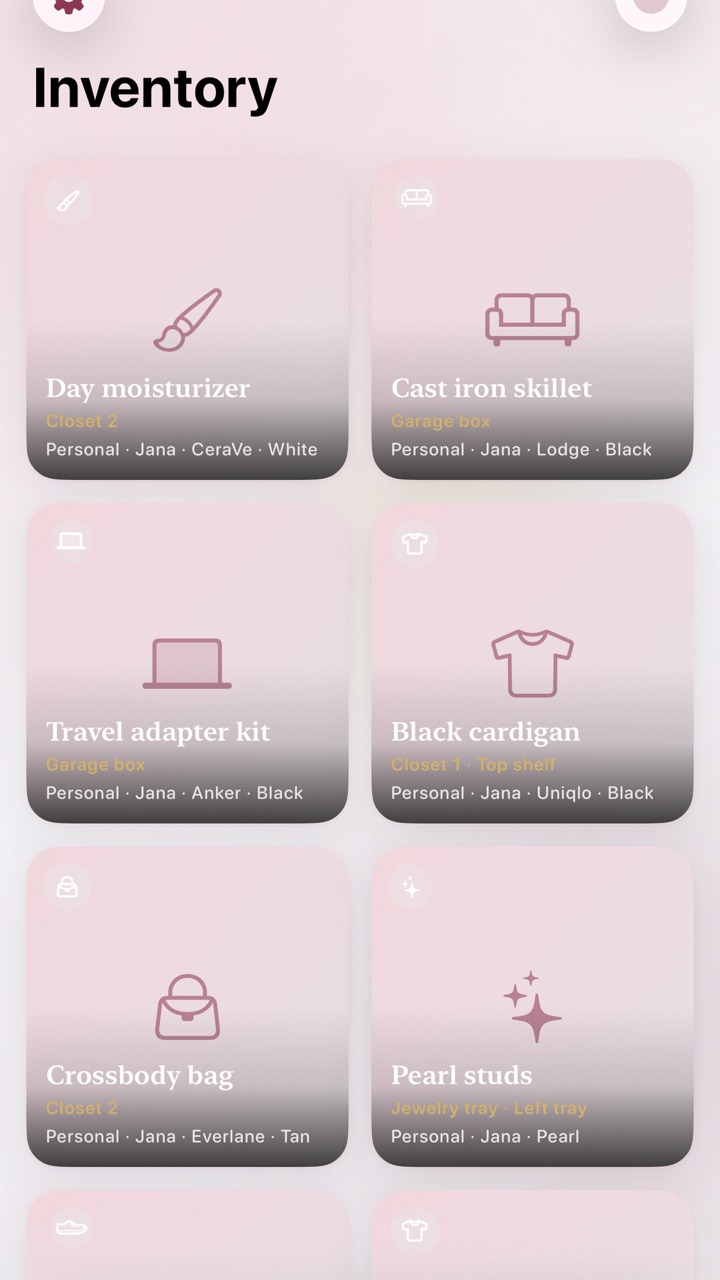
It’s easy to forget what is already at home—especially when it is tucked into a closet, a storage bin, or a drawer you do not open every day. You see something useful while shopping, remember that you might own one, and have to decide without knowing where to look.
A simple inventory can make that moment less guesswork. It does not need to cover every object in your home. Start with the kinds of things you most often search for or accidentally buy twice, and build a record you will actually use.
Start with one repeat-purchase category
Choose a small, familiar group: charging cables, travel accessories, scarves, kitchen tools, or the supplies you tend to buy when you cannot remember what is left. The best place to start is not necessarily the most valuable thing you own. It is the thing that creates a recurring “I thought we had one” moment.
You can add items as you come across them. There is no need to empty a room or make a complete list before the inventory becomes useful.
Give each item a name you will recognize
Use ordinary words you are likely to remember later. “USB-C cable, long” is easier to find than a vague label such as “electronics.” If two items are easy to confuse, add a distinguishing detail in the item name or its note—color, size, model, or what it goes with.
The goal is not perfect cataloging. It is to make the item recognizable to the person who will look for it: you, a family member, or future-you in a hurry.
Record where you would look first
A location can be simple: desk drawer, hall closet, top shelf, or travel bag. Pick words that make sense in your home. A useful location answers “where should I check?” without turning every item into a mapping project.
If you move something, update its location when you notice. A slightly imperfect record that you keep current is more useful than a detailed system you stop maintaining.
Make the check part of the buying decision
Before ordering a replacement or buying another version, take a moment to check the category or item you recorded. If you find what you need, you can confirm it is the right one. If you do not, you have learned something useful too—and can add the new item to your record when it arrives.
An inventory cannot prevent every duplicate purchase. Items get used up, lent out, moved, or missed. But having a place to check can replace a vague memory with a clearer answer.
Keep the effort proportional
Start with five or ten items, then stop. Add more only when doing so solves a real annoyance. The point is to reduce the effort of remembering—not to create another chore.
Nestlogue is a personal catalog for what you own and where it lives. You can start with up to 50 items free; your catalog stays on your device, and no account is required. Get Nestlogue on the App Store or Google Play.
If you would rather begin with a small area than a category, see our guide: How to start a home inventory, one small area at a time.